
Operations & Manufacturing
Order and Procurement Forecasting for Manufacturers: From Demand to Delivery
Learn how manufacturers can connect customer orders, material requirements, inventory, suppliers, and production using Oorini.
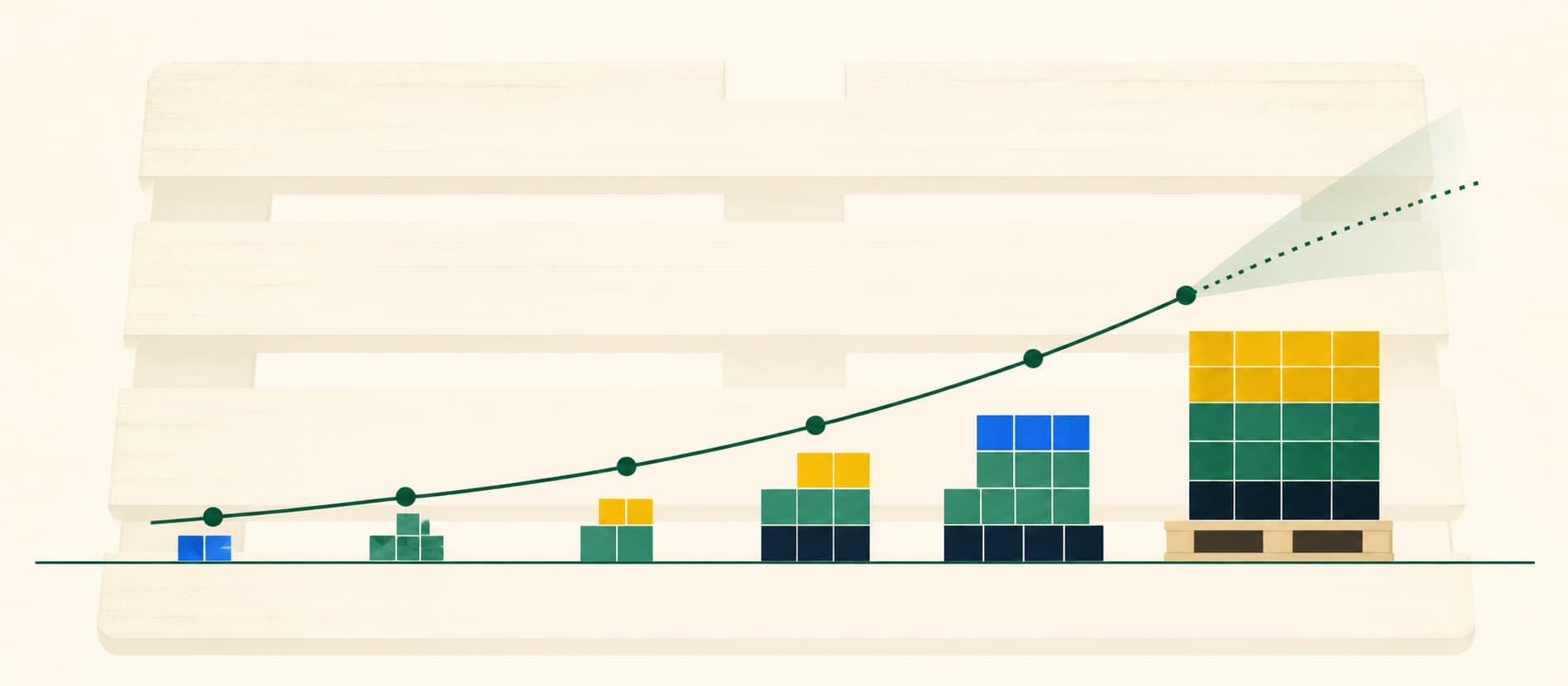
Order and procurement forecasting helps manufacturers estimate what customers will buy, when those orders must be produced, and which materials need to be purchased in advance.
It connects sales, planning, purchasing, inventory, production, finance, and delivery. When these teams work from separate spreadsheets and disconnected systems, small changes in demand can quickly become material shortages, delayed orders, excess inventory, or expensive last-minute purchases.
Oorini helps manufacturers bring these activities into one connected workflow. Customer orders, bills of materials, inventory levels, purchase orders, production jobs, supplier receipts, and financial records can all work from the same operational data.
Why order forecasting and procurement forecasting belong together
Order forecasting estimates expected demand. Procurement forecasting translates that demand into the materials and components needed to fulfil it.
For example, a manufacturer may expect an order for 500 pallets, cabinets, boxes, or finished assemblies. That forecast must then be converted into requirements for lumber, sheets, hardware, packaging, coatings, or other components.
A useful procurement forecast considers:
- Current inventory
- Materials already reserved for orders
- Open purchase orders
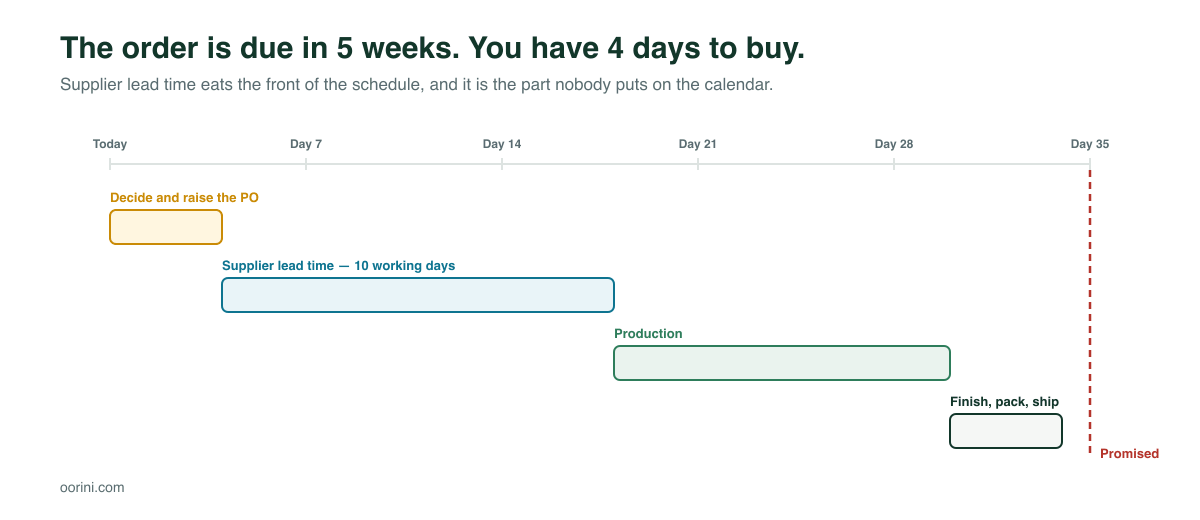
- Supplier lead times
- Bills of materials
- Minimum order quantities
- Production schedules
- Expected waste and scrap
- Safety stock
- Supplier delivery performance
Oorini supports this connection through product and component records, BOM-based material calculations, inventory tracking, order management, and purchase-order workflows.
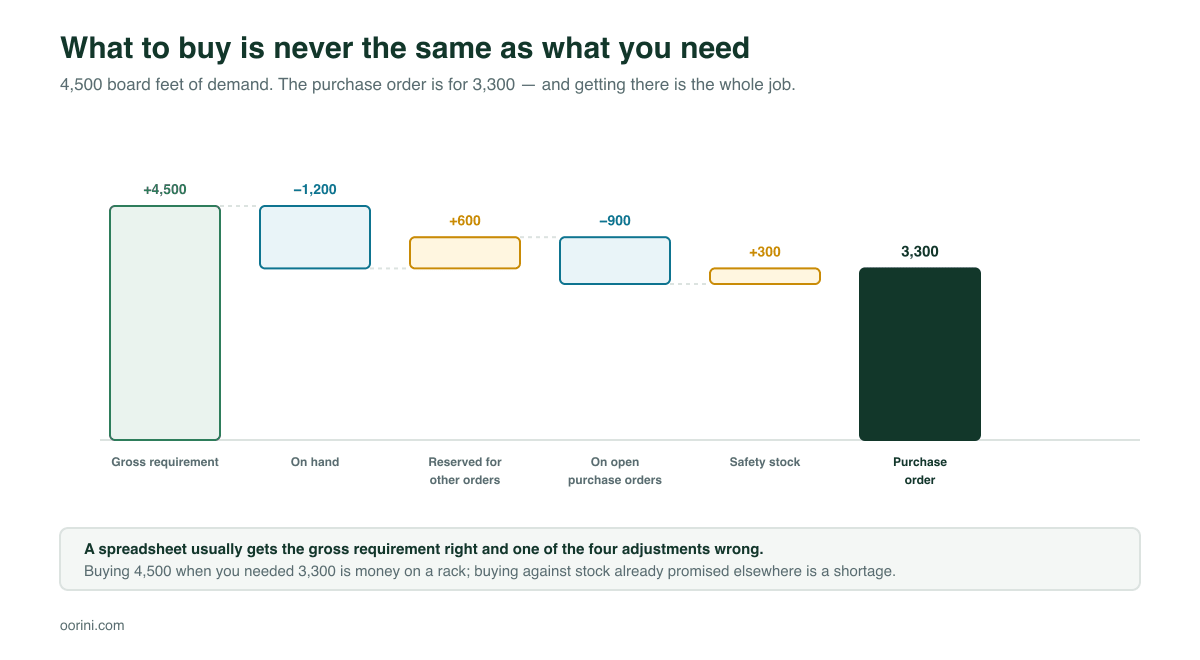
When a customer order is confirmed, the business can see not only the finished product requirement, but also the material demand behind it.
Why spreadsheet-based forecasting becomes unreliable
Spreadsheets can be useful when a business is small and demand is stable. They become harder to manage as product lines, customers, suppliers, and locations grow.
A spreadsheet forecast may not show that:
- Inventory has already been reserved for another order
- A supplier shipment is late
- A material is available at one location but not another
- A component is shared by several products
- A product requires a particular material grade or specification
- Actual production waste is higher than the original estimate
- A customer order has been brought forward
- A purchase order has only been partially received
This creates a common manufacturing problem: inventory appears sufficient at a high level, but the business still cannot complete the required production.
Oorini provides a more operational view of inventory. Teams can monitor total stock, reserved quantities, available quantities, on-order materials, location-level stock, usage patterns, and price history.
That gives planners and purchasing teams a more accurate starting point for their decisions.
Turning customer orders into material requirements
The first step is connecting finished products to their components and source materials.
For example, a pallet product may require:
- Top boards
- Bottom boards
- Runners
- Blocks
- Nails or fasteners
- Packaging materials
A custom furniture product may require specific sheet materials, edging, hardware, finishes, and packaging.
With Oorini, products can be mapped to components and materials. The system can then calculate the material requirements associated with an order. Unit conversions help businesses buy materials in one unit while tracking or consuming them in another, such as sheets, square feet, linear feet, board feet, or pieces.
This is especially useful for manufacturers working with wood, sheet goods, hardware, and other materials that are purchased, stored, and consumed in different units.
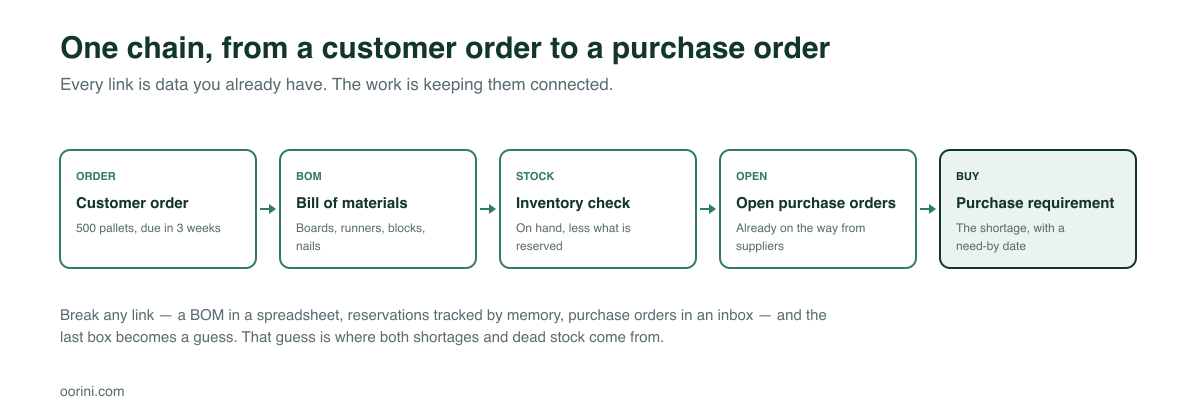
The process becomes:
- A customer order is created or confirmed.
- Oorini identifies the required products and quantities.
- The product BOM determines the required components and materials.
- Available inventory and reserved stock are checked.
- Existing purchase orders are included in the calculation.
- Shortages and reorder requirements become visible.
- Purchasing can create or review the appropriate purchase order.
This reduces manual re-entry and gives purchasing a direct connection to real customer demand.
From low-stock alert to purchase order
Procurement forecasting should lead to an accountable action. That action may be a new purchase order, a supplier follow-up, a production reschedule, a stock transfer, or a review of the customer delivery date.
Oorini supports several steps in this workflow.
When material levels fall below a reorder point, the system can generate a low-stock alert and show upcoming material requirements. Reorder suggestions can take into account usage patterns, supplier information, lead times, minimum order quantities, and pending orders.
Purchasing teams can then create a purchase order with:
- The selected supplier
- Material specifications
- Quantity and unit of measure
- Unit price
- Expected delivery date
- Terms and conditions
- Shipping location
- Internal notes
Purchase orders can move through an approval workflow before being emailed to the supplier or generated as a professional PDF.
This gives the business a record of what was requested, who approved it, when it is expected, and which customer or production requirements it supports.
Better receiving and supplier visibility
Creating a purchase order is only one part of procurement. The business also needs to know what was actually delivered.
Oorini supports partial receiving, discrepancy tracking, receiving history, storage locations, and optional receipt photos. Warehouse teams can scan or enter a purchase-order number, verify the delivered quantity, and record where the material was stored.
When the receipt is completed:
- Inventory quantities are updated
- The purchase-order status changes
- Partial deliveries remain open for the balance
- A receiving document is created
- The related supplier bill can be created for accounts payable
- Purchasing has a record of ordered versus received quantities
This information also supports supplier performance tracking. Over time, businesses can identify suppliers that frequently deliver late, ship incomplete quantities, or change prices unexpectedly.
That makes procurement forecasting more realistic. A supplier’s stated lead time is useful, but actual delivery history is often more valuable.
Keeping procurement aligned with production
Material availability is only useful when it is connected to production.
Oorini connects confirmed orders with production workflows and job cards. Production teams can track steps such as cutting, assembly, finishing, quality control, and packing from a tablet or shop-floor interface.
As production progresses, materials can be issued against jobs and actual consumption can be compared with expected consumption.
This helps answer questions such as:
- Which orders are ready to start?
- Which jobs are waiting for materials?
- Which material shortages threaten customer delivery dates?
- Where is production slowing down?
- Is actual material usage higher than the BOM estimate?
- Are waste levels affecting profitability?
For woodworking companies, this visibility is particularly important. A shortage of one board size, sheet, or hardware item can prevent a larger order from being completed even when most other materials are available.
Connecting purchasing, inventory, and production helps teams identify these constraints earlier.
Using AI as decision support
AI can improve forecasting by identifying patterns across orders, usage, inventory, supplier performance, and production data. It may help highlight seasonal demand, unusual order activity, slow-moving materials, or changing consumption patterns.
However, AI should support planners and buyers rather than replace their judgement.
A recommendation may not account for:
- A new customer with no reliable order history
- An engineering change
- A supplier allocation
- A quality or compliance requirement
- A material that is obsolete or difficult to replace
- A major cash-flow constraint
- A customer commitment that has not yet been confirmed
The best approach is to use automation for repetitive, low-risk tasks while keeping people responsible for significant purchasing decisions.
In Oorini, businesses can configure workflows and automations around events such as:
- A material reaching its reorder point
- An order being confirmed
- A production job being created
- A purchase order being approved
- Materials being received
- An invoice becoming overdue
Automation reduces administrative work while keeping approvals and accountability in place.
Build a reliable forecasting foundation
Technology cannot compensate for inaccurate master data. Before relying heavily on forecasting, manufacturers should review:
- Active and obsolete material codes
- Product and component definitions
- Bills of materials and revisions
- Units of measure
- Supplier lead times
- Minimum order quantities
- Reorder points
- Inventory locations
- Reserved and quarantined stock
- Material costs and price history
Oorini gives businesses a structured place to maintain this information, but the data still needs to be reviewed and owned by the appropriate teams.
Start with the materials that have the greatest effect on customer commitments, production downtime, cash flow, or material waste. Improving the records for the most important items can deliver more value than trying to clean every record at once.
A practical implementation approach
Manufacturers can introduce order and procurement forecasting in stages:
- Choose one product family or material group with recurring demand.
- Map its products, components, and materials.
- Review inventory quantities and supplier information.
- Connect confirmed orders to material requirements.
- Set reorder points and approval rules.
- Track purchase orders from creation through receipt.
- Compare expected versus actual material consumption.
- Measure stockouts, expedites, excess inventory, supplier delays, and production interruptions.
The goal is not to produce a perfect forecast. The goal is to give the right person enough warning to take the right action.
The practical advantage: more time to act
Order and procurement forecasting is valuable because it shortens the time between a changing customer signal and an operational response.
With Oorini, manufacturers can connect orders, BOMs, inventory, purchasing, suppliers, production, and finance in one system. Teams can see what is available, what is reserved, what is on order, what is at risk, and what action is required next.
That may mean ordering materials earlier, consolidating purchases, contacting a supplier, adjusting production, qualifying an alternative, or discussing a revised delivery date with the customer.
The future will always contain uncertainty.The advantage comes from recognising risk early and turning it into an accountable decision before it becomes a shortage, delay, or emergency purchase.