
Operations & Manufacturing
Shop-Floor Signals: Find Manufacturing Margin Loss Before Month-End
Output, scrap, downtime and labour already tell you where margin is leaking. Learn which floor signals matter, how to interpret them, and how to act before the job closes.
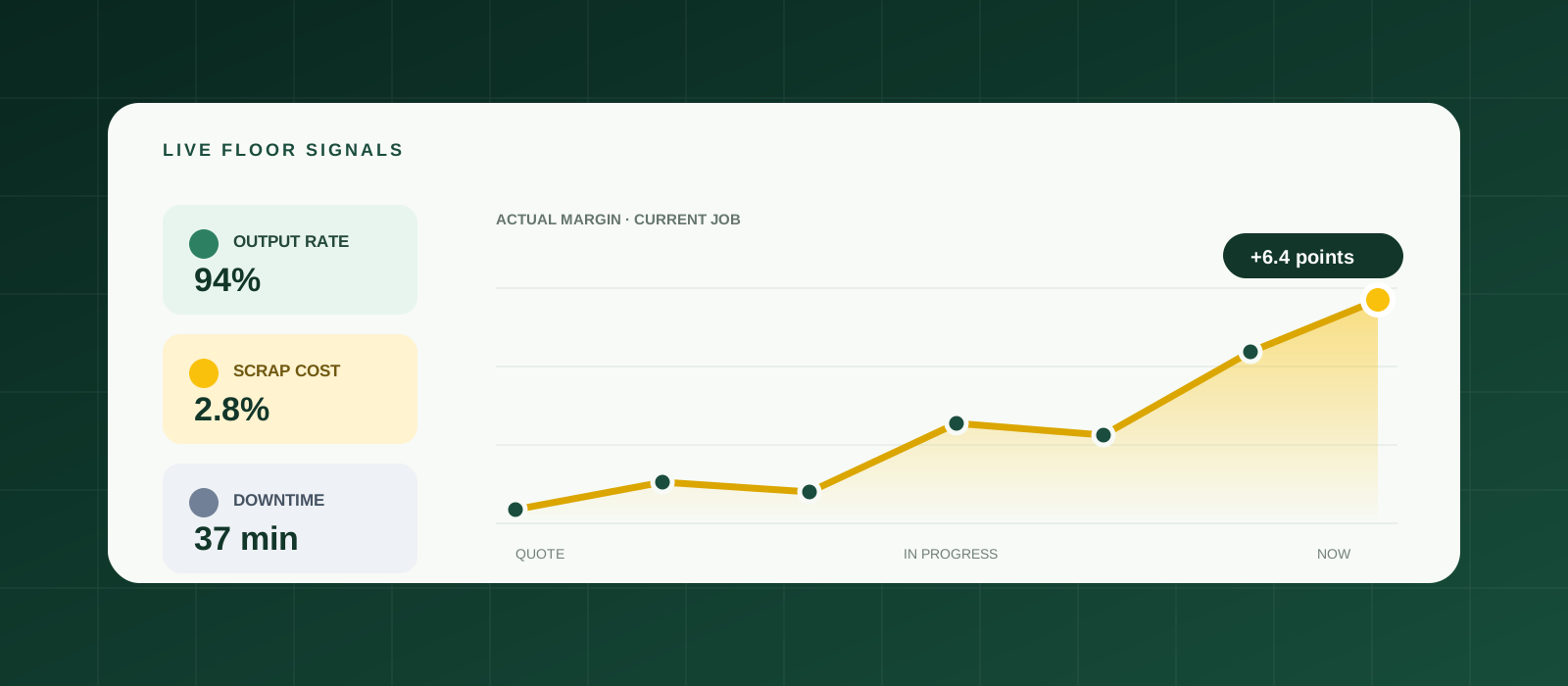
A job can look healthy in the order book and still lose money on the floor. The quote was accepted, material was purchased, and the promised date still looks reachable. Yet an hour of unplanned downtime, a second setup, a little more scrap than expected, and two extra people on the operation can quietly consume the margin before anyone sees the final job-cost report.
The answer is not a bigger month-end spreadsheet. It is a small set of shop-floor signals connected to the job while there is still time to act. This guide explains which signals matter, what they mean together, and how a small or mid-sized manufacturer can turn daily production evidence into better margin decisions.
Margin disappears through variance, not one dramatic event
Most margin loss is cumulative. A machine waits twelve minutes for material. An operator produces below the planned rate for part of a shift. A batch fails inspection and is reworked. None of those events appears catastrophic in isolation, but each one changes the actual cost of the job.
The useful question is not simply, “Did production finish?” It is, “What did this job consume to produce the accepted output?” That means bringing four signal families into the same operational record:
- Output: accepted units, completed quantity, cycle time and progress against the plan.
- Material: actual issues, substitutions, scrap, recovery and yield.
- Time: labour minutes, machine runtime, waiting time and downtime.
- Quality: first-pass yield, rejected quantity, rework and inspection outcomes.
A floor metric becomes a margin signal only when it is connected to the job, product, operation, time and cost that created it.
The four signals worth watching during a job
1. Output rate against the planned rate
Output rate is the earliest warning that the labour and machine assumptions behind a quote are drifting. Compare accepted output per hour with the rate used to plan or price the operation. A shortfall does not automatically mean poor performance: the cause may be a difficult material batch, an unfamiliar product, a changeover, or a machine problem. It does mean the job deserves attention.
Use a rolling window that is long enough to smooth ordinary cycle variation but short enough to act on. For a fast process that may be thirty minutes. For low-volume fabrication it may be one completed operation or batch.
2. Yield and scrap cost, not scrap percentage alone
A two-percent scrap rate can be harmless on a cheap input and severe on an expensive one. Record the actual input quantity, accepted output, recoverable material and disposal quantity. Then value the loss using the material cost attached to that job.
Yield also exposes problems that a scrap bin does not. If 1,000 kilograms enter a process and only 930 kilograms are accounted for across good output, by-products, recoverable offcut and waste, the missing 70 kilograms is an operational question. It may be normal process loss, a measurement issue, or unrecorded scrap—but it should not be invisible.
3. Downtime with a reason and a boundary
“Machine stopped” is not enough. Separate planned setup, maintenance, material shortage, quality hold, operator unavailability and equipment failure. Those reasons lead to different actions and different owners.
Attach each event to a start time, end time, workstation and job stage. This creates a clean cost boundary. The team can see whether the current job absorbed the loss, whether maintenance should own it, and whether the same failure is repeating across products.
4. Actual labour against the operation estimate
Labour variance is often misunderstood because elapsed time and labour time are not the same. A two-hour operation attended by three people consumes six labour hours. A four-hour automated run checked periodically by one operator may consume far less than four labour hours.
Capture who worked, when they joined or left, and whether the operation requires full attendance. This lets the system allocate labour without charging the same person to two simultaneous jobs or treating unattended machine time as direct labour.
Read the signals together
Individual metrics can mislead. Higher output is not an improvement if scrap rises faster. Lower labour time may be false efficiency if rework appears at the next quality gate. Reduced downtime may simply mean operators are no longer recording small stops.
A practical review combines the signals in a simple sequence:
- Compare accepted output with the planned quantity and rate.
- Reconcile actual material input with good output, recovery and waste.
- Review downtime by reason and identify any event outside the normal allowance.
- Compare actual labour and machine time with the job estimate.
- Recalculate expected job margin using the evidence captured so far.
This turns “margin” from a historical finance number into an operating forecast. Supervisors do not need a perfect final cost every minute. They need an honest direction of travel and a clear explanation of what changed.
Use thresholds that trigger a decision
A dashboard full of red tiles creates noise. Define a small number of thresholds tied to actions. For example:
- Output rate below 90 percent of plan for two consecutive intervals: supervisor checks the constraint.
- Material yield below the approved route tolerance: hold the batch and reconcile quantities.
- Unplanned downtime above fifteen minutes: capture a reason and maintenance response.
- Forecast margin below the order threshold: review price, scope, process or recovery before more cost is committed.
The threshold should identify a decision point, not punish the operator reporting it. If people learn that recording a stop creates blame, the data will improve on paper while the process gets worse.
Start with one route and one weekly review
Do not begin by instrumenting every machine. Choose one repeatable product route where the commercial estimate and the production steps are already understood. Define the expected quantities, rates, resources and labour assumptions. Then collect actuals for a few complete jobs.
Review the difference weekly with production, purchasing and sales in the same conversation. Production can explain the floor event. Purchasing can identify material price or quality changes. Sales can decide whether future quotes need a different allowance. That closed loop is where better data becomes better margin.
If capacity itself is driving the variance, read our guide to building a schedule around real machine and labour availability. If the missing link is how much execution detail to capture, compare MRP and Traceable Production.
What good looks like
A connected operation can answer three questions before the job closes: Are we making acceptable output at the expected rate? Are actual material and time still inside the commercial allowance? If not, what event changed the result?
That is enough to improve the current job and the next quote. The goal is not surveillance or a perfect digital twin. It is a reliable feedback loop from the floor to the decisions that determine delivery, cost and price.
Frequently asked questions
Start with accepted output against planned output for one operation, then add the actual material consumed and direct labour time. Together, those measures reveal the largest quantity, yield and time variances without creating a heavy reporting burden.
Recalculate when meaningful new evidence arrives: a material issue, completed operation, recorded downtime event, scrap entry or labour clock-out. For management review, a daily exception view and weekly route review are usually more useful than a constantly flashing dashboard.
Yes. Ask for information at natural work boundaries such as start, pause, completion, material issue and quality check. Reuse the signed-in worker and known job context so the operator records the exception or quantity—not data the system already knows.